Soviet Art

USSR Culture

Painting by Soviet artist Boris Fyodorov
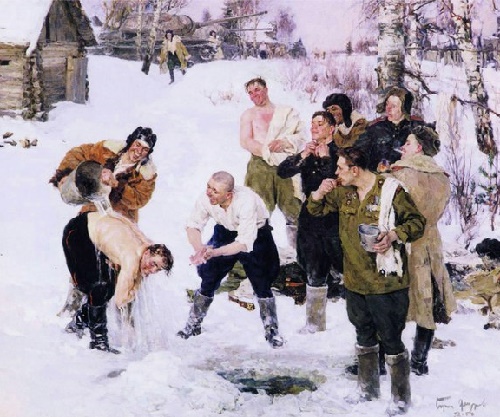
Morning of tank crew. 1952-1954. Painting by Soviet artist Boris Fyodorov

Morning of tank crew. 1952-1954. Painting by Soviet artist Boris Fyodorov (born August 15, 1922)

Soviet artist Boris Fyodorov was born August 15, 1922 in Samara, the USSR. At nineteen years old, while a student of the Leningrad Institute of Painting, Sculpture and Architecture of Repin, he volunteered to the front. In 1942-44 he fought at Leningrad and 2nd Baltic fronts as a senior mechanic-driver of a heavy tank “HF”. He was wounded twice. In 1945, on the instructions of War Artists Studio of MB Grekov was assigned to the 79th Rifle Corps, involved in the storming of the Reichstag – drew from nature the raising flag over the Reichstag. He was awarded the Order of “Red Star”, “Fame”, “World War II” 2 degrees, medals “For Courage”, “For Victory over Germany”, “For the capture of Berlin.” In the 1945 he continued studying at the Faculty of Painting of the Leningrad Institute of Painting, Sculpture and Architecture of IE Repin, the workshop of M.I.Avilov. His diploma work was “Gorky and Chekhov among artists of Moscow Art Theatre.
Read more »
Soviet Ukrainian painter Vladimir Nesterov

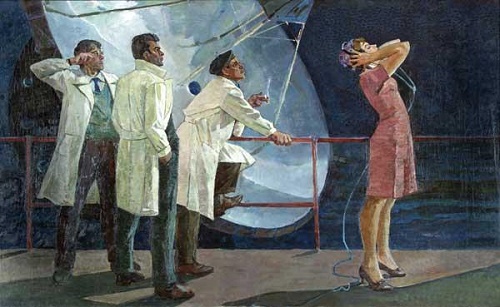
Vladimir Nesterov (1932). Listening to space (Earth listens). 1970. Canvas, oil. Sold at auction of $ 72,063

Soviet Ukrainian painter Vladimir Nesterov (born 1932). Listening to space (The Earth listens). 1970. Canvas, oil. Sold at auction for $ 72,063

Soviet Ukrainian painter Vladimir Nesterov was born August 16, 1932 in the city of Kherson. Vladimir Dmitrievich – an artist of social realism, a teacher, a member of the USSR Union of Artists. While studying in the art studio of Kherson Pioneers House, he was awarded a trip to Moscow for the watercolor painting “Duel of Pushkin with Dantes.”
After returning from the capital, the young man was invited to lead an art studio in the House of Folk Art. Within months, the number of visitors to his studio reached seventy.
Later Nesterov graduated from the Kiev Art Institute. His graduate work at the Institute was devoted to one of the most favorite themes in the Soviet Art – Space exploration. Then he created two paintings “The Earth is listening” and “The Astronauts”. He studied all that was available about space exploration, traveled to the Crimean observatory, collected materials. In 1970 he painted “The Earth is listening”, it was on the show in Moscow, later was sold at auction for $ 72,063.
Read more »

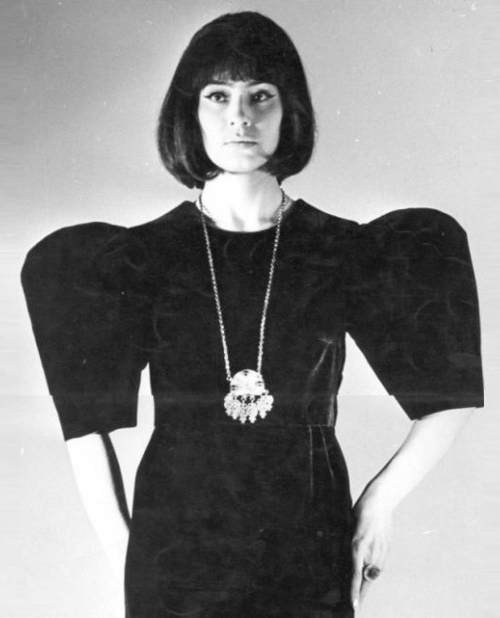
Soviet fashion model Leka Mironova

Soviet fashion model Leka Mironova

Soviet fashion model Leka Mironova

Soviet fashion model Leka Mironova (full name – Leocadia Mironova) – one of the most famous models of 1960-70s USSR. Like most of models of the time, to the Fashion House on Kuznetsky Most, she came by chance to support a girlfriend, a novice fashion designer Vyacheslav Zaitsev saw her. He immediately offered her to work with him. Leka has just graduated from high school. She studied ballet, but had to leave dancing because of illness of feet. She wanted to enter the faculty of architecture, but also failed because of vision problems. And she agreed to try herself as a fashion model. Leka became known abroad and was called “Russian Audrey Hepburn” for the resemblance to the great actress. After shooting in the American film “The Soviet Union Stars” (one of them, by the way, was Maya Plisetskaya), Leka was invited to a parade of top fashion models in the world.
Read more »

Soviet landscape painter Aleksei Gritsai

Soviet landscape painter Aleksei Gritsai. Summer garden. Pastel. 1955

Soviet landscape painter Aleksei Gritsai (1914 – 1998). Summer garden. Pastel. 1955

Soviet landscape painter Aleksei Gritsai (1914 – 1998) – teacher, professor, Corresponding Member (1957), Academician of the USSR Academy of Arts (1964). People’s Artist of the USSR (1974), winner of the USSR State Prize (1978) and two Stalin Prizes third degree (1951, 1952). He did a lot for the revival of the Russian landscape in the post-war Soviet art. In the revolutionary and post-revolutionary Russian avant-garde art, and then in the Soviet art of 1930-1950-ies landscape was not popular. However, after the war, returning from the war artists began to look at the world through different eyes. Gritsai was one of these artists, who preferred the pure landscape in the art study. In addition, Gritsai was an outstanding teacher. He taught and then led a workshop at the Moscow State Institute named after Surikov, headed a commission of the Academy of Arts on the work with young artists.
Read more »

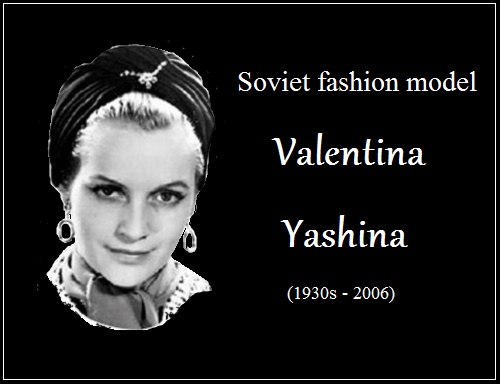
Soviet fashion model Valentina Yashina

Soviet fashion model Valentina Yashina

Soviet fashion model Valentina Yashina (1930s – 2006)

Soviet fashion model Valentina Yashina was one of the most beautiful models of the USSR in 1950-70s and her success was phenomenal. Blond goddess, Soviet Greta Garbo, fashion icon – so Yashina was described in the foreign press. In the capital’s Fashion House at Kuznetsky Most she worked for almost half a century, and appeared on the podium, even at the age of 65! Surprisingly, compatriots often called her beauty obscene and apparently out of jealousy even tried to blame her in the opposition to society. Many believed that life of Yashina was like a fairy tale. But at the end of this tale, alas, it turned out to be tragic … In her declining years, to survive, she had to work as a cleaner. Yashina got a legacy of more than five million dollars, but in her 70 years of age, she could barely make ends meet in a tiny room in a communal apartment. Ten years ago, the model was found dead in her country house in Kupavna of the Moscow region.
Read more »

Soviet Armenian sculptor Nikolai Nikogosyan

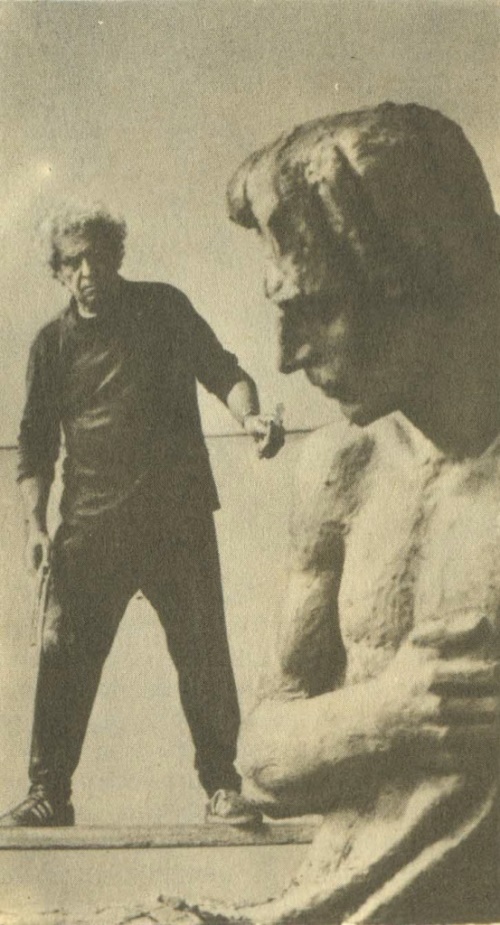
N. Nikogosyan working on a model of the monument to the poet Vahan Terian. 1986

Soviet Armenian sculptor Nikolai Nikogosyan (born 1918) working on a model of the monument to the poet Vahan Terian. 1986

Works of Soviet Armenian sculptor Nikolai Nikogosyan entered the “golden fund” of Soviet art. They are in the Russian Museum, the Tretyakov Gallery, Moscow Museum of Modern Art, Museum of Fine Arts of Karelia and other regional museums in Russia, as well as in the State Art gallery of Armenia, in the art museums of former Soviet Union – Belarus, Kazakhstan, Latvia, Lithuania. Nikolai Nikogosyan – painter, graphic artist, teacher, People’s Artist of the USSR (1982), Winner of USSR State Prize (1977). Corresponding Member (1983) of the USSR Academy of Arts, Academician of Russian Academy of Arts (2001). Nikolai Bagratovich Nikoghosyan was born December 2, 1918, in the village of Shagrar (now Nalbandyan) in Armenia. In 1930-1940-ies N.B.Nikogosyan got an excellent education – first at the Institute of Painting, Sculpture and Architecture of All-Russian Academy of Arts in Leningrad, and later at the Moscow Art Institute of Surikov (workshop AT Matveyev). Since 1985, he taught at the Faculty of Architecture plastics, since 1998 professor. In 1940, the artist began to participate in exhibitions, in 1942 he joined the USSR Union of Artists. In 1956 he represented the country at the XXVIII International Biennale of Contemporary Art in Venice.
Read more »

Soviet Russian artist Tatyana Nazarenko

Soviet Russian artist Tatyana Nazarenko. Self-portrait with her son. Oil. 1977

Soviet Russian artist Tatyana Nazarenko (born June 24, 1944, Moscow, USSR). Self-portrait with her son. Oil. 1977

Soviet Russian artist Tatyana Nazarenko
From the window of her studio – a fabulous view of the golden-domed Moscow with stars, roofs and domes. Depending on the lighting and the time of year, this urban landscape bears different moods: from the intoxicating delight of the beauty of the world in a clear winter morning to viscous melancholy of autumn evening, when the city acquires a sinister silhouette outlines. All these changes of breath, shades of feeling of a big city are recorded with the utmost sincerity in the artist’s paintings. But it is not a landscape, no. Reflection takes place in people’s faces, in their fates, which are disclosed to the canvas in a leisurely scenic narrative. And the city, as something fatal, always visible behind them.
Read more »