Soviet Art

USSR Culture

Soviet sculptor Albert Sergeyev

Soviet sculptor Albert Sergeyev (30 April 1926 - December 12, 2003). Evening in the village. Aluminum. 1985

Soviet sculptor Albert Sergeyev (30 April 1926 – December 12, 2003). Evening in the village. Aluminum. 1985

Soviet sculptor Albert Sergeyev (30 April 1926 – December 12, 2003) – member of USSR Union of Artists, Honored Artist of the RSFSR (1975), People’s Artist of the RSFSR (1986), veteran of the Great Patriotic War (1941-1945). Albert Sergeyev was born April 30, 1926 in the village of Levenko of Smolensk province. A few years later the family moved to Vyazma, where he spent his childhood. Since the age of eleven worked in the art studio, organized by a talented amateur painter Sergei Vladimirovich Zhuravlev, where he acquired initial skills of drawing, painting and composition. In 1944 he went to the front, fought in the Baltic artillery scout fighter regiment. AG Sergeev never parted with a pencil – at the request of his comrades drew their portraits for their letters to family.
Read more »

Creator of new life – Man of labor in Soviet art

Creator of new life - Man of labor in Soviet art. I. Serebryanyi. A steelworker of the plant named after SM Kirov. Oil. 1950

Creator of new life – Man of labor in Soviet art. I. Serebryanyi. A steelworker of the plant named after SM Kirov. Oil. 1950

Creator of new life – Man of labor in Soviet art

Realistic art is always responsive to the radical transformation of life – the revolutionary events, social change, building a new society. Since the decrees of the Soviet power and the first Five-Year Plans in our fine arts observed the emergence of new themes, new hero – the creator and builder. And the old, original art for the classic theme of labor takes on a special meaning, unusual urgency. A man and a working man in his work – an inquisitive, searching, active, looking into the future, a real creator and master of life – a collective image of a multinational Soviet art born of the Great October Revolution. How it has changed over the years, in the course of events, a series of tests? On this question eloquently respond the best works of Soviet artists – from established classics to our contemporaries.
Read more »

Soviet journal Young Artist 1936-2016

Soviet journal Young Artist 1936-2016

Soviet journal Young Artist 1936-2016

80 years ago, in July 1936, was published the first issue of the Soviet journal Young Artist. While much was done for the first time in the USSR. In the daily lives appeared new concepts and words that have now become legendary – Turksib, Magnitogorsk, Metrostroy, five-year plan, Komsomol, Artek, Stakhanovite, Chelyuskinskaya heroic epic … This time, reflected by the artist’s brush or the chisel of the sculptor, visibly comes alive before your eyes, when you leaf through the yellowed binders of prewar magazines. On their pages – works of Soviet Art masters Vera Mukhina, Boris Ioganson, Sergei Gerasimov, Alexander Deineka. The achievements of socialist fine arts stand on a par with their time. And the creation of the monthly magazine “Young Artist” – also notable step showing the care of a young Soviet state for the spiritual education of youth.
Read more »

Soviet photographer Gennady Bodrov

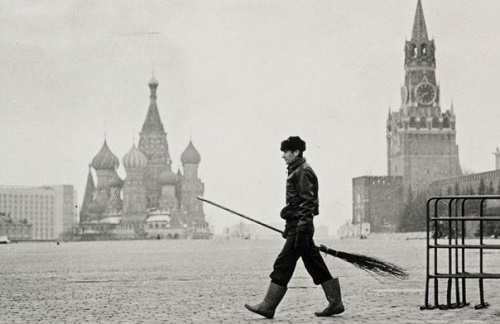
Photo by Soviet photographer Gennady Bodrov (May 17, 1957 - February 14, 1999)

Early morning. Red Square, 1988-1990. Moscow USSR. Photo by Soviet photographer Gennady Bodrov (May 17, 1957 – February 14, 1999). Image source kursk.com

The shot from the series “Black and white Russia” by Gennady Borisovich Bodrov (May 17, 1957 – February 14, 1999), made in 1988-1990, evaluated at 2-3 thousand pounds at Sotheby’s auction. Soviet photographer Gennady Bodrov was born in 1957 in the city of Soltsy of Novgorod region. In his childhood, aged ten, he injured his hand examining the found shell left from the Great Patriotic war (1941-1945). At school, in the early 70s he became interested in photography. Then his first cameras were “Kiev” and “Zenith”. He studied by correspondence at the national University of Arts in 1973 – 1976. In 1974, immediately after graduation, he began working with newspapers. He worked as the head of photo club, assistant cameraman, a photographer for the newspaper. In fact, Gennady Bodrov was a freelance photographer.
Read more »

Soviet artist Igor Radoman 1921-1992

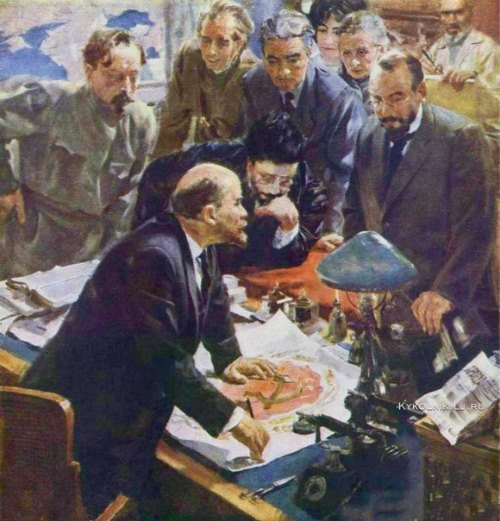
Soviet artist Igor Radoman (1921 - 1992). Adoption of the emblem of the RSFSR, 1960

Soviet artist Igor Radoman (1921 – 1992). Adoption of the emblem of the RSFSR, 1960

Soviet artist Igor Radoman (1921 – 1992) – Member of the Moscow Union of Artists (1944), Honored Artist of the RSFSR. Bright Soviet painter, muralist, author of genre works on historical-revolutionary theme, a series of portraits of socialist statesmen, intellectuals, his contemporaries. He has also worked in the genre of landscape and still life. For 50 years of creative activity IV Radoman made a significant contribution to each of these types and genres of Soviet art. He participated in the painting of the Kharkov railway station, the station “Kievskaya” of the Moscow Metro. Radoman created a series of multi-image panels for the Soviet pavilion at the International Exhibition in Beijing and Leipzig. Solo exhibitions were held in Moscow (1968, 1978, 1980, 2004). Artworks of the Soviet artist are in the State Tretyakov Gallery, the State Historical Museum, Museum of Arts of Uzbekistan, the Central Museum of the Great Patriotic War, and the other largest art museums of the former USSR.
Read more »

Soviet artist Stepan Yegorovich Orlov

Soviet artist Stepan Yegorovich Orlov (1929-2003). Distant 1941st (seeing off to the front)

Distant 1941st (seeing off to the front). Soviet artist Stepan Yegorovich Orlov (1929-2003)

Soviet artist Stepan Yegorovich Orlov – member of the USSR Union of artists (1970), Honored Artist of Tuva ASSR (1982), Honored Artist of the RSFSR (1991). Born on August 3, 1929 in the village of Kalugin, Kazakh SSR, Stepan Orlov spent his childhood and adolescence in Magnitogorsk, the Urals. To survive during the difficult years of war, the boy had to begin working at the age of twelve. He worked at the Central Club of builders as an apprentice of artist. And in 1947 – as the artist in the open-hearth shop of the plant, simultaneously studying at night school. Then, in 1955 he entered the Leningrad Art College of Serov. After graduation from the college, in 1960, he arrived in the Siberian city of Krasnoyarsk. There he began working in the Art Fund. His first steps in Soviet art connected with the romance of the construction of the Krasnoyarsk hydroelectric power station in the city of Divnogorsk. The first work – “Portrait of a welder Reutsky”. Then followed a series of portraits, which brought him the deserved fame of a brilliant portrait artist. His work combines restraint and inner strength, deep emotionalism, images filled with drama.
Read more »

The image of Stalin in the Soviet art

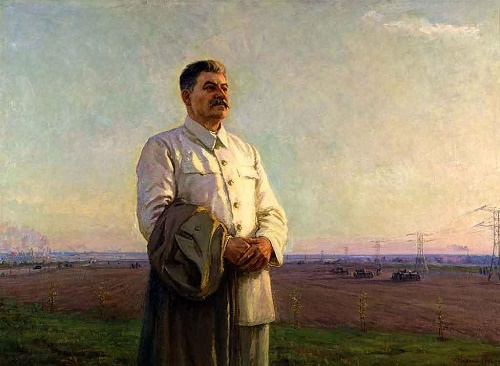
The image of Stalin in the Soviet art. Fyodor Shurpin. The morning of our country. 1946-1948. The State Tretyakov Gallery

The image of Stalin in the Soviet art. Fyodor Shurpin. The morning of our country. 1946-1948. The State Tretyakov Gallery

To portray a leader – does not mean to see the leader. His life is shrouded in mythology. The image of Stalin in the Soviet art — it is a work of art, not documentary evidence. “There is no art for art’s sake, there can not be any “free”, independent of society, as if standing above this society artists … They just are not wanted. Yes, these people can not exist”. This is a quote from Stalin’s speech at the meeting with the creative intelligentsia in 1946. A topic worthy of a Soviet student of early 1950s – “The image of Stalin in the Soviet art.” Immediately comes to mind iconic painting “The morning of our homeland” by Fyodor Shurpin where peoples father stands on the background of the infinite blue sky and fields with dozens of random tractors. He – the conqueror of space. Moreover, its creator, tired with a greatcoat over his right hand after a good cause, similar to the Creator on the “sixth day”: “That was not bad.”
Read more »