Soviet Art

USSR Culture

Category Archive: Soviet Art

Soviet painter Victor Tsyplakov
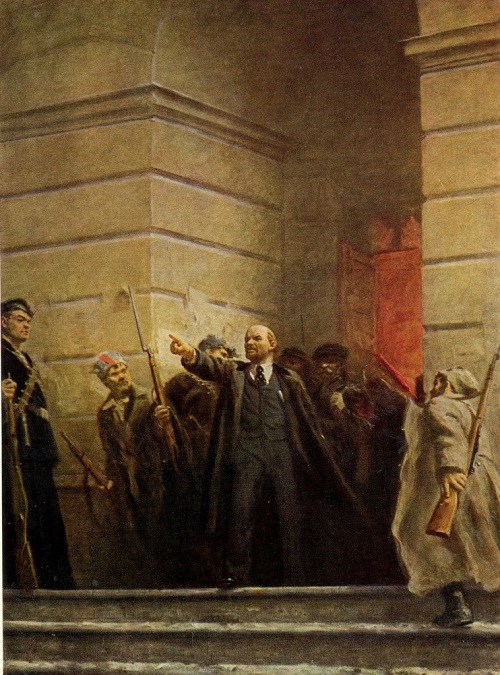
Soviet painter Victor Tsyplakov. (1915-1986), Lenin. 1947. Oil on canvas. The Central Lenin Museum

Vladimir Lenin. 1947. Oil on canvas. Soviet painter Victor Tsyplakov (1915-1986). The Central Lenin Museum

Soviet painter Victor Tsyplakov
Corresponding Member of the USSR Academy of Arts (1967), Tsyplakov was People’s Artist of the RSFSR (1975), and twice winner of the Stalin Prize of the second degree (1950). The award, in particular, for his painting “The advanced people of Moscow in Kremlin” (collective work with other prominent Soviet artists). Also, for a series of other paintings. Popularity came to Tsyplakov for his works “Gorky on the Volga” (1945), “V. Lenin” (1947), and “The interrogation of Zoya Kosmodemyanskaya” (1945). Noteworthy, he was one of the few artists allowed to make sketches at funeral of Stalin in 1953. Tsyplakov had solo exhibitions of his artworks in 1956, 1986 and 2007 in Moscow. To date, his works are in the State Tretyakov Gallery, the Russian Museum, as well as the major museums of the former USSR.
More »
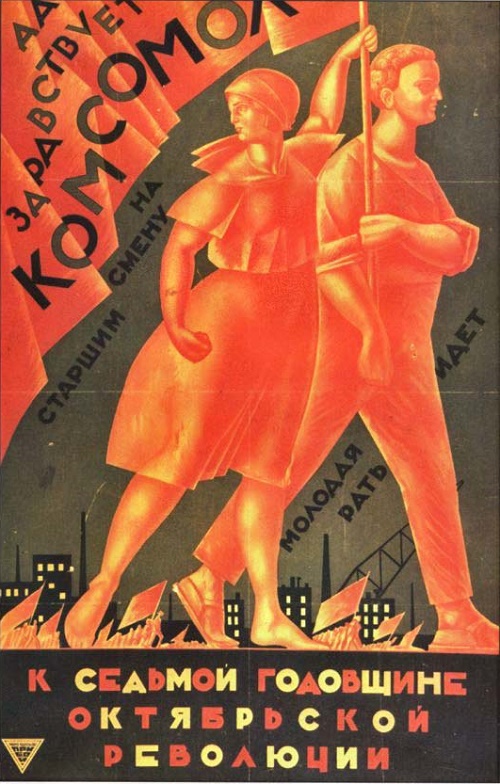
Great October Soviet Art

Great October Soviet Art. Long live Komsomol. Poster to the 7th year of October revolution, 1924

Great October Soviet Art. Long live Komsomol. Poster to the 7th year of October revolution, 1924

Great October Soviet Art
The emotional element of the October period, its romantic pathos expressed in an extraordinary variety of design tools. Grandiose mystery and theatrical performances, colorful panels, sometimes occupying hundreds of square meters, manufacture symbols, emblems and grotesque images, masks, dolls – all distinguished by colorful festive brightness. Life seethed, saturated with overflowing energy of youth. Easel – sculptors, painters and graphic artists working on paintings of agitation ships, steams, and agitation trains, on panels, banners, developing projects of monuments, emblems designs, state signs, seals and stamps. Bloomed mass books and periodicals. The broadest development got agitation and mass art form, almost all masters gave a tribute to it. Propaganda art of that time was embracing. It captured the theater, poetry, architecture, painting, and even elegant porcelain …
More »

Art belongs to the people. Vladimir Lenin

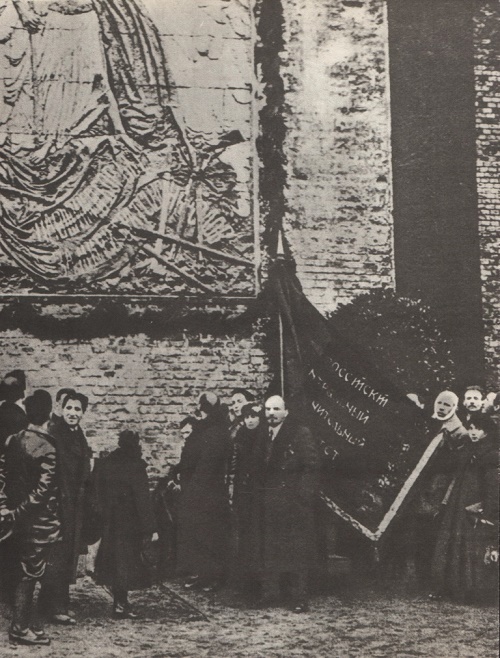
VI Lenin in Red Square near the Kremlin wall in front of a plaque installed in memory of the fallen for peace and brotherhood of peoples (by S. Konenkov). November 7, 1918

VI Lenin in Red Square near the Kremlin wall in front of a plaque installed in memory of the fallen for peace and brotherhood of peoples (by S. Konenkov). November 7, 1918

Art belongs to the people. Vladimir Lenin
There are ideas that capture the minds of the masses, become a symbol of social renewal of the world. They excite minds, destroy obsolete judgments, illuminate the way of struggle and work for people. These are the thoughts and deeds of Lenin. His name is a new era in the history of mankind. Live Leninist word transcended national borders, stirred the hearts and minds of the working people all over the world. The leader of the first workers’ state in the world paid constant attention to complex processes that took place in the artistic life of the young republic, to the arts as an important means of ideological and aesthetic education. “Art belongs to the people. It must leave its deepest roots in the very thick of the working masses. It should be understood for the masses and loved by them. It must unite the feelings, thoughts and the will of the masses and raise them. It should awaken artists in them and develop them.” These Leninist statements define the purpose of Soviet artist of serving people.
More »

Masters of Soviet caricature Kukryniksy

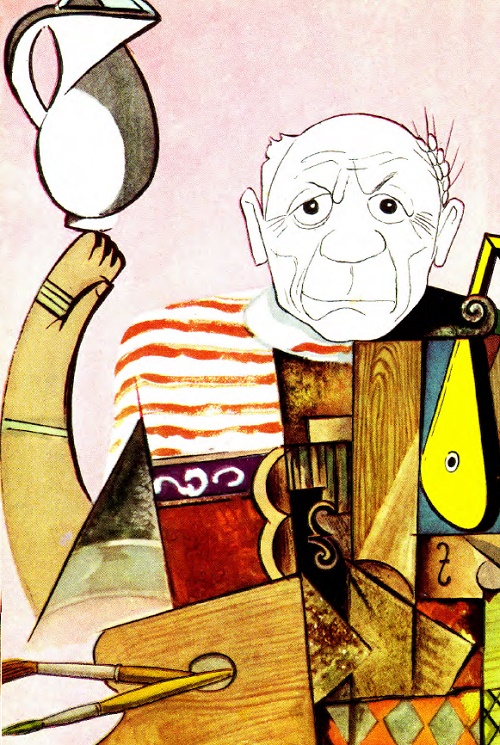
Picasso by Masters of Soviet caricature Kukryniksy

Picasso by Masters of Soviet caricature Kukryniksy, 1961. Published by magazine “Crocodile”, USSR

Masters of Soviet caricature Kukryniksy – creative team of Soviet graphic artists – Mikhail Kupriyanov (1903-1991), Porfiry Krylov (1902-1990) and Nikolay Sokolov (1903-2000). They were full members of the Academy of Arts of the USSR (1947), People’s Artists of the USSR (1958), Heroes of Socialist Labor. Their pseudonym “Kukryniksy” is made up of the first syllables of their names. Three artists worked by collective creativity (each also worked individually – on portraits and landscapes). The greatest popularity brought them numerous masterfully executed caricatures and cartoons, as well as book illustrations created in the typical style of caricature.
More »

Soviet artist Indulis Zarins

Soviet artist Indulis Zarins (1929-1997). Soldiers of revolution. 1965

Soviet artist Indulis Zarins (1929-1997). Soldiers of revolution. 1965

Latvian and Soviet artist Indulis Zarins (1929-1997) – member of the Union of Artists of the Latvian SSR (1960), member of the USSR Academy of Arts (1978). Member of the Communist Party since 1964. Winner of the Lenin Prize (1980), People’s Artist of the USSR (1986). People’s deputy of the USSR, honorary member of the Royal Academy of Arts. The work of Zarins is characterized by emphasizing the nuances, expressive color, contrasting colors. In the 1960s – 1970s, most notably the impact of the “severe style” themes of the paintings were mostly working people, builders of socialism, of the revolution and the Civil War. Also painted portraits, still lifes, transferred to canvas impressions of long-distance travel or read books. Often consciously went for the merger of genres. He has participated in exhibitions since 1956. The most famous works: “What a height!” (1958), a triptych “Soldiers of the Revolution” (1962-1965), “Blizzard” (1968), “Portrait of the artist Boris Berzins” (1964), “Kaspar and Kristaps” (1969), “Cubic Still Life” (1973), “Florence” (1967), “Rome” (1980), “Don Quixote” (1979), “Self Portrait” (1980), “Artist Leo Svemps in the studio” (1987), two cycles of paintings dedicated to the Latvian riflemen.
More »

Soviet warrior artist Vladimir Pereyaslavets

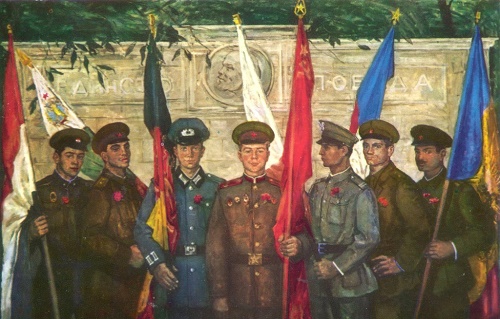
Soviet warrior artist Vladimir Pereyaslavets. Warsaw Pact. Oil. 1970

Soviet warrior artist Vladimir Pereyaslavets (born 1918). Warsaw Pact. Oil. 1970

The painting “Warsaw Pact” shows soldiers of the socialist countries, standing under the banners of their armies, representing a reliable support of peace and happy creation of the fraternal peoples. In the military labor of the Soviet Army, he sees the guarantee of peace and protect, as the most precious and valuable on the Earth. Creativity of Soviet warrior artist Vladimir Pereyaslavets is inextricably linked with the army. People’s Artist of the RSFSR Vladimir Pereyaslavets – military officer, pilot and painter, whose life is connected with the art and the army. Vladimir Pereyaslavets (born November 22, 1918) – Soviet Russian painter, teacher, artist of studio of military artists of MB Grekov since 1950. Corresponding Member (1995), Academician of Russian Academy of Arts (2002), People’s Artist of the RSFSR (1980). Colonel of USSR Armed Forces, retired. Member of the Union of Artists since 1957.
More »

Leningrad Secondary Art School

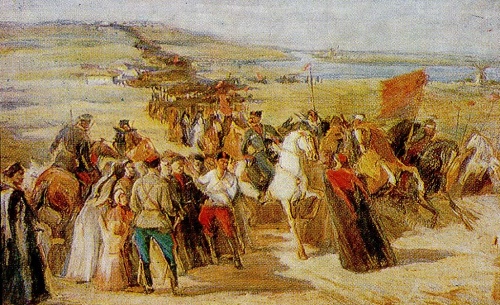
The works of students of the Leningrad Secondary Art School. Alexey Eryomin. The squad to Budyonny. Oil. 1938

The works of students of the Leningrad Secondary Art School. Alexey Eryomin. The squad to Budyonny. Oil. 1938

Leningrad Secondary Art School (now St. Petersburg State Academic Art Lyceum of BV Ioganson of the Russian Academy of Arts) was the first in the USSR specialized secondary art school for gifted children. Creation of the first in the country’s secondary art school was a clear indication of the party cares about the future of the Soviet culture. This school was needed then (and today too) to provide a strong realist traditions in Soviet art. To change a decent education – those who will carry on in their creations memory of the people. Each graduated from Leningrad Art School carries the torch of high traditions of national art coming from the ancient times, from the beginning of the Russian Academy. Look at the pictures of school pupils. What distinguishes them? First of all, the depth of feelings, understanding of life, professional skills. After all, they are made by teenagers undoubtedly talented, but many have proven this throughout their further creative life.
More »