Soviet Art

USSR Culture

Category Archive: Soviet Art

Soviet artist Vladimir Stozharov
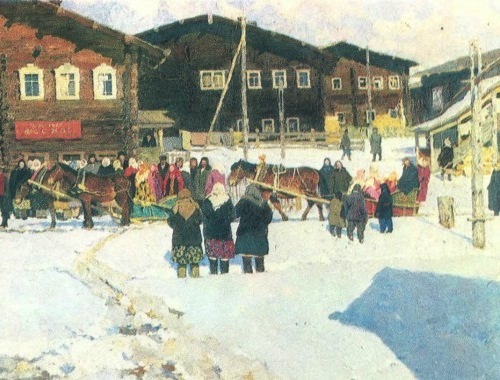
Soviet artist Vladimir Stozharov. Vazhgort farewell to winter. Oil. 1966-1967

Vazhgort farewell to winter. Oil. 1966-1967. Soviet artist Vladimir Stozharov (January 3, 1926 – November 22, 1973)

Soviet artist Vladimir Stozharov (January 3, 1926 – November 22, 1973) – Honored Artist of the RSFSR (1965), laureate of the State Prize of the RSFSR of Repin (1968) – for the painting “New North”, “White Night. Vazhgort Village”, “Saturday”, “Big Village Pyssa”, “Isady” from the series of landscapes in the North of Russia. In 1973 the artist was elected a Corresponding Member of USSR Academy of Arts. It was a great artist and generous talent, who had his school, his theme in painting. Twenty years of hard and fruitful work, entirely devoted to the cherished creative idea for a constant improvement of skills made a name of Stozharov inseparable from the classics of Soviet realist painting. His artistic career ended too early, and many of his ideas remained non-embodied.
More »
Soviet graphic artist Vladimir Favorsky

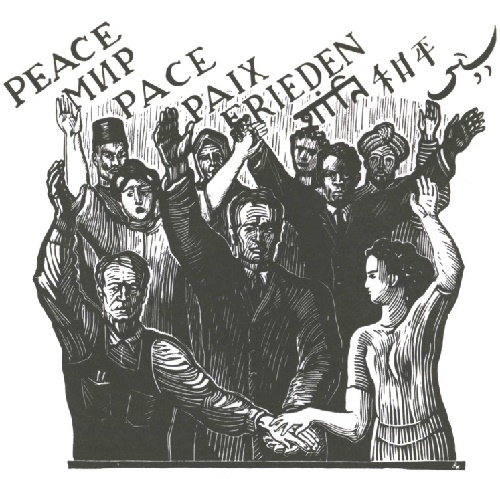
Soviet graphic artist Vladimir Favorsky. Peace. Linocut. 1961

Soviet graphic artist Vladimir Favorsky (1886-1964). Peace. Linocut. 1961

Soviet graphic artist Vladimir Favorsky (1886-1964) was born at the turn of two epochs, and lived in the first half of the twentieth century, when established traditional art was replaced with carrying a giant boost of energy and ideas new forms. To the spirit of the analysis Favorsky contrasted the spirit of synthesis and to the decay of art into its constituent elements – integrity. Vitalizing beginning in his creativity – direct trace of the great traditions of Russian art and culture. Soviet graphic Vladimir Favorsky – master of portrait woodcuts and book illustrations, designer, painter, muralist, teacher and theorist of fine arts, professor. Corresponding Member of the USSR Academy of Arts (1957), Academician (1962), People’s Artist of the USSR (1963), winner of the Lenin Prize (1962).
More »

Soviet Palekh art

Wind of Revolution in Soviet Palekh Art

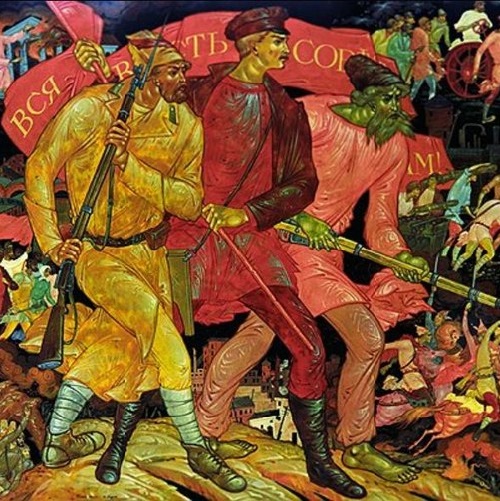
V. Khodov. Wind of Revolution. Plate. 1969. Soviet Palekh Art

In the panel “Wind of Revolution” symbols are already in the title. Its figurative embodiment – the central figures of a Soldier, Worker and Peasant, and dramatically different scale figures in the scenes about the different stages of the revolutionary struggle. The dynamic pattern, vigor movements of characters, generalized color, built on the hot shades of red and golden ocher, give special expressiveness to the composition. Soviet Palekh art, where socialist realism bizarrely mixed with the iconography tradition, was born after the victory of the Great October Revolution, in the early 1920s. Great artists, former masters of iconography created it. The miniature painting on black-lacquered boxes made of papier-mache, in the technique and methods of ancient Russian painting, carefully maintaining its high poetic structure. It turned out the old plastic arts, fine, accurate drawing, emotional expressiveness of color, the very technique give enormous opportunities to reflect the events of the day. Pioneers of Soviet Palekh laid the basic principles of miniature painting, later developed by more than one generation of masters.
More »

Leniniana by Soviet artist Nikolay Andreyev

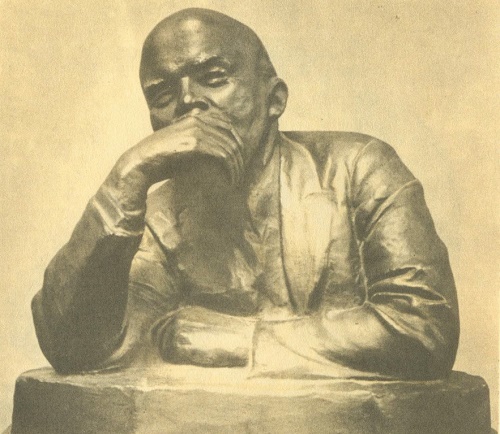
VI Lenin. The first half of the 1920s. Gypsum, covered with varnish. Leniniana by Soviet artist Nikolay Andreyev

VI Lenin. The first half of the 1920s. Gypsum, covered with varnish. Leniniana by Soviet artist Nikolay Andreyev (14 October 1873 — 24 December 1932)

Leniniana by Soviet artist Nikolay Andreyev
The image of Vladimir Lenin has long attracted the attention of artists. Appeared a lot of portraits of the leader of the Great Proletarian revolution in painting, sculpture, drawings and engravings. Many of them are successful. However, the first place, without doubt, belongs to Soviet artist Nikolay Andreyev – pioneer of “Leniniana” (created around 100 sculptures and 200 graphic images of Lenin) … Gogol monument, Monument to Alexander Ostrovsky, Statue of Herzen and Ogarev in Moscow – all works of the sculptor NA Andreev (14 October 1873 — 24 December 1932). From the very first days of the Great Proletarian Revolution Andreev became irrevocably on its side. And the origin, and a large, serious mind and sharp observation helped him to properly understand and appreciate the significance of the October Revolution. Most of all his attention attracted the personality of the leader of the revolution. Artist persistently sought a meeting with Vladimir Ilyich, following him everywhere, where Lenin spoke publicly at rallies, meetings and congresses.
More »

Unknown artist Ivan Chistov

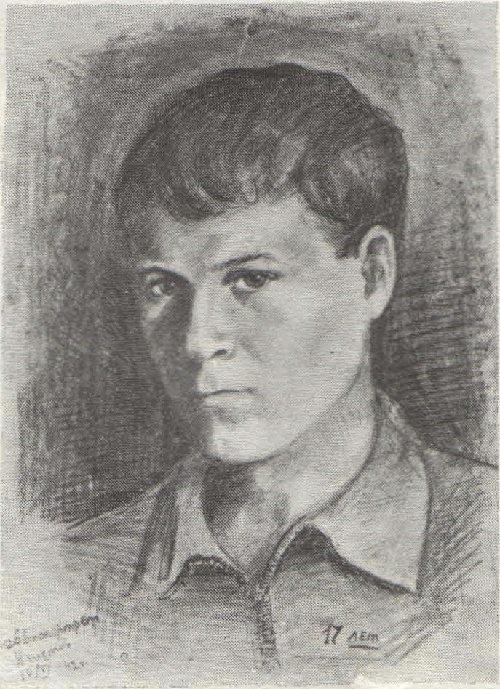
Unknown artist Ivan Chistov. Self-portrait. Pencil. 1942

Unknown artist Ivan Chistov (1925-1943). Self-portrait. Pencil. 1942

Talented but unknown artist Ivan Chistov, an orphan, who in the difficult time of war lived with some kind old lady, who loved him as her own grandson. She was proud of Vanya – a top student at school, and one of the first and most diligent students in the art studio. The head of the art studio Stanislav Kachinsky always set him as an example to others in the Studio. The boy perfectly sculpted from clay, even tried to make a sculpture out of found somewhere a piece of marble. Ivan was good at pencil drawing and oil painting. About love and devotion of Ivan to the art say the pages of his diary, which he started in January 1942. But the war went on, and instead of a pencil, brush and paints in the hands of an 18-year-old artist Ivan Chistov was now the gun – 16 August 1942 he left for the front. He became a hunter on German tanks. A year later, his grandmother got a short message – “Anti-tank rifleman Ivan Chistov was killed near the village of Shui of Ekimovichevsky district of Smolensk region, September 10, 1943”. He was 18.
More »

Soviet artist Inna Shirokova

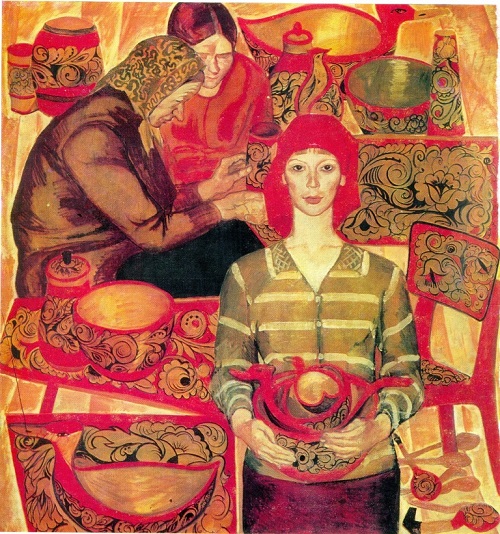
Soviet artist Inna Shirokova (b. 1937) Khokhloma. 1969. Oil on canvas

Soviet artist Inna Shirokova (b. 1937) Khokhloma. 1969. Oil on canvas

Soviet artist Inna Shirokova – member of the USSR Union of Artists (1968), Honored Artist of the RSFSR (1987). Her canvas – positive, bright holiday, whether it’s a portrait or still life – there is always a place for items of crafts – Gzhel, Khokhloma, Dymkovo toy. Kirov based artist explains – “I was brought up on Dymkovo toy, and other folk crafts. Besides, I was in Gorky, and there flourished Khokhloma, Gorodets painting, and Polkhov-Maidan painting. Always Gzhel and ceramics drew my attention. Still life with these items in my view, go beyond just painting, and add to the whole canvas elegance and festivity, and it is close to me in spirit… All my life I was very fond of my work, often waking up at night, thinking about how to make my paintings more expressive. And now I can hardly spend a day without my studio… I always knew that the artist must work carefully, a lot, passionately, and the audience will appreciate it”.
More »

Nadezhda Krupskaya in Soviet Art

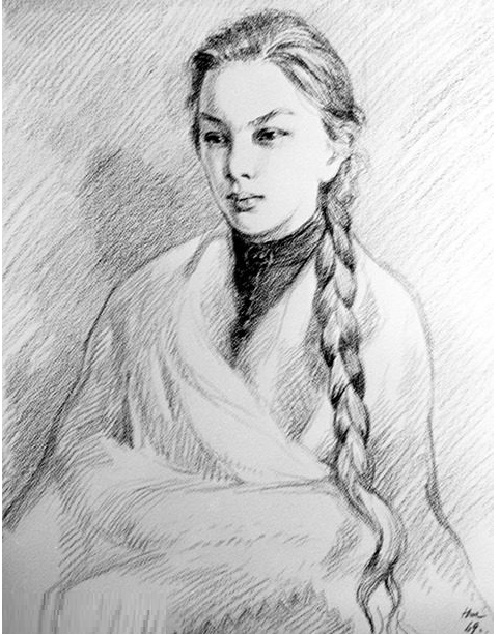
Nadezhda Krupskaya in Soviet Art. Nikolay Zhukov (1908-1973). Portrait of Nadezhda Krupskaya. Pencil. 1969

Nadezhda Krupskaya in Soviet Art. Nikolay Zhukov (1908-1973). Portrait of Nadezhda Krupskaya. Pencil. 1969

Nadezhda Krupskaya in Soviet Art
Nadezhda Krupskaya (1869 – 1939) dedicated her life to the struggle for the happiness of the working people, for communism. Much effort and energy she gave to the complex challenges of science teaching, the creation of the Soviet school, the formation of education system based on new principles. She saw this as one of the necessary conditions for the successful building of socialism in the USSR. Lenin spoke highly of pedagogical activity of Krupskaya. Nadezhda Krupskaya is considered one of the founders of Soviet pedagogy. Her ideas, tips to this day are of great importance. As a gifted teacher, a Marxist, Krupskaya was able to see far ahead, and many of her ideas born at the dawn of life of the USSR, had a huge effect. Maybe not everyone knows that Krupskaya was an active promoter of the fine arts, considering it as a powerful means of communist education of the younger generation.
More »