Soviet Art

USSR Culture

Category Archive: Soviet Art

Soviet painter Vyacheslav Shumilov 1931-2004
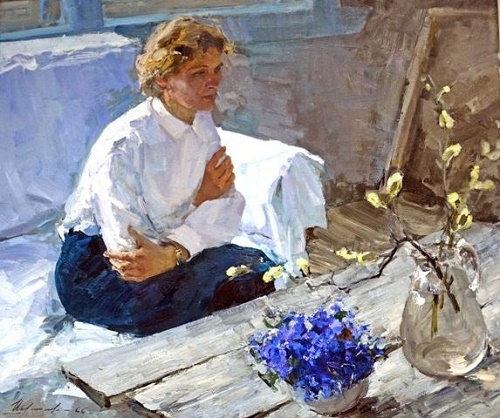
Wait for me. Soviet painter Vyacheslav Shumilov

Wait for me. Soviet painter Vyacheslav Shumilov (1931-2004)

Soviet painter Vyacheslav Shumilov – People’s Artist of Russia, awarded the Silver Medal of the Russian Academy of Arts. Chairman of the Board of the Kalinin (Tver) organization of the USSR Union of Artists. Born in 1931 in Tver, Shumilov Vyacheslav Fedorovich
began his creative life in 1950s. He graduated from Moscow Art and Industrial School of memory of 1905 (1949-1953). And already in 1956 became a participant of the All-Union and republican exhibitions of Soviet art.
In 1956, he first visited the Academic Dacha of I.E. Repin, where he worked under the direction of A.P. Bubnov. This trip played a huge role in the formation of the young artist and largely determined his fate. “Academic dacha” became for him not only a school, but also a permanent place of work, a corner of inspiration, and an inexhaustible source of topics and subjects of his paintings.
More »
Soviet Russian graphic artist Yuri Aksyonov

Soviet Russian graphic artist Yuri Aksyonov

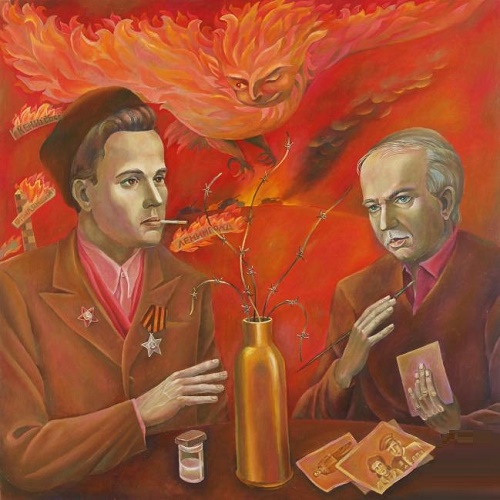
Father and son. 2015. Oil, canvas. Painted for the 70th anniversary of the Victory in the Great Patriotic War. Sons became older than their early departed fathers. The son remembers his father, the WWII member. Above them is a fiery bird of fate. Soviet Russian graphic artist Yuri Aksyonov (born 14 February 1950)

Soviet Russian graphic artist Yuri Aksyonov
Born on February 14, 1950 in Tyumen, Yury Alexeyevich Aksyonov studied in Leningrad. He completed two years at the Leningrad Higher School of Industrial Art named after Vera Mukhina. For six years (1971-1977) he worked as an artist-designer in the Tyumen branch of the Art Fund of the RSFSR. From the same period he began to participate in exhibitions of Soviet art. However, in 1977 he moved to Vladivostok for permanent residence. There, for 15 years (1977-1992) worked as an artist-designer in the Primorsky branch of the Art Fund of the RSFSR. In particular, he specialized in designing and sketching interiors, chasing, monumental painting, and easel graphics.
The artist works fruitfully both in painting and in graphics. But it is in the graphics that he is most organic, and it is in the graphics that his recognizable handwriting was formed. The works of Yury Aksyonov remind old frescoes. They are laconic, the figures are majestic and calm, and faces are distinguished by large, regular features.
More »

Pioneers in paintings of Soviet artists

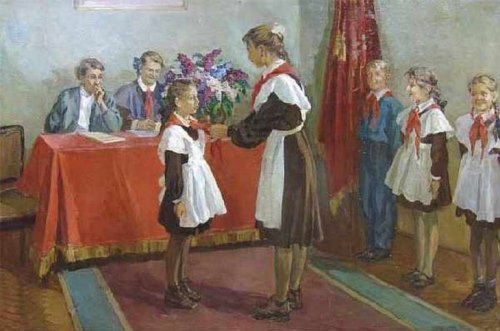
Pioneers in paintings of Soviet artists. Ya. V. Titov. Admission to the pioneers

Admission to the pioneers. Ya. V. Titov. Pioneers in paintings of Soviet artists

Pioneers in paintings of Soviet artists
The pioneer organization was not a “sect of young communists”, as Western propaganda represented it, but a children’s and youth association that cultivated positive qualities and a spirit of camaraderie, which today is so lacking for modern children. It is from the absence of pioneers and Komsomol that young people today are trying to unite in military-patriotic clubs, football games and other associations of varying degrees of legality. In Soviet times, everything that modern youth is looking for was given by the Pioneer and the Komsomol.
For those who were pioneers, this time meant hikes, campfires, sports competitions, exciting games, developing clubs and other pleasant memories. Pioneers were almost all who managed to live in the USSR at the age of over 10 years. At the dawn of the pioneer organization, only the best ones were accepted there, but then the criteria were reduced, and by the 1970s and 1980s they began to accept everyone.

More »

Interpreting USSR kitsch Soviet artist Arkady Petrov

Interpreting USSR kitsch Soviet artist Arkady Petrov

Self-portrait. 1981. Interpreting USSR kitsch Soviet artist Arkady Petrov (born 1940)

Interpreting USSR kitsch Soviet artist Arkady Petrov (born 1940). His art, as well as many of his contemporaries, actually fell into the category of “forbidden” in Soviet times. His paintings almost never appeared on official exhibitions, although in the artistic environment his authority was quite high. Born in 1940 in the village near Gorlovka in the Donbass (and then Stalin) region, he spent his childhood in the miner’s province. Meanwhile, aged 17, he moved to Moscow (1957). After graduating from the Art School “In Memory of 1905”, in 1963-1969, he studied at the Moscow State Art Institute of Surikov. During the Soviet era, authorities hardly allowed his works, and in Soviet times he had only one solo exhibition. However, The Russian Museum became the first museum that acquired the artist’s canvases as far back as the 1970s. Besides, he gained fame in perestroika as the author of one of the individual versions of social art.
More »

Soviet painter Mikhail Kornetsky 1926-2005

Soviet painter Mikhail Kornetsky. Lenin on subbotnik. Red square. 1986

Lenin on Subbotnik. Red square. 1986. Soviet painter Mikhail Kornetsky (March 15, 1926, Moscow – September 10, 2005, Riga)

Soviet painter Mikhail Kornetsky (March 15, 1926, Moscow – September 10, 2005, Riga) – member of the USSR Union of Artists (1961), Honored Artist of the Latvian SSR. Kornetsky was born on March 15, 1926 in Moscow. His father, Vladimir Kornetsky, after the revolution participated in the Civil War and from 1922 until his death in 1947 worked in the Soviet state security organizations. His mother, Venilia Indrikovna Liepa, also worked there. Since 1943, the mother of the future artist moved to Riga work in the prosecutor’s office and on the liberation of Latvia from the Nazi invaders.
More »

Soviet Russian avant-garde artist Aristarkh Lentulov

Soviet Russian avant-garde artist Aristarkh Lentulov (January 16, 1882 - April 15, 1943)

Great Painter, 1915. Self-portrait. Soviet Russian avant-garde artist Aristarkh Lentulov (January 16, 1882 – April 15, 1943)

Soviet Russian avant-garde artist Aristarkh Lentulov (January 16, 1882 – April 15, 1943) – an outstanding painter and stage designer. Born in the village of Nizhny Lomovo, Penza province, in the family of a village priest. So, studying in the spiritual school and the theological seminary became a natural continuation of the family tradition. And, apparently, Lentulov would become a priest as well as his father. However, the gift given by God intervened in the fate of the young man. Beginning to draw from early childhood, along with his brother Boris, he entered the newly created art school of Seliverstov (1898). Noteworthy, Lentulov received the most elementary skills of the craft from his teachers – in Penza from the Wanderer Savitsky and illustrator Afanasyev. Besides, here, in Penza in 1908 was his first solo exhibition. Fifteen works of Lentulov, stored in the Penza gallery relating to different periods of his creative activity, allow us to clearly trace the evolution of the master.
More »

Soviet portrait artist Tatyana Oranskaya 1914-1982

Soviet portrait artist Tatyana Oranskaya. Chinese revolution woman. 1960

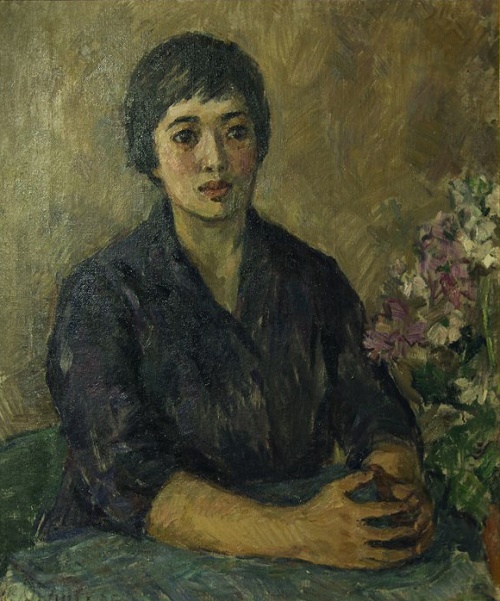
Chinese revolutionary woman. 1960. Soviet portrait artist Tatyana Oranskaya (1914-1982)

Soviet portrait artist Tatyana Oranskaya
Born 22 January 1914 in Moscow, Tatyana Alexandrovna Oranskaya studied in the workshops of F.I. Ferberg (1931-1934). Then, in 1936 – 1937 she improved her skills in the Institute for Advanced Training of Artists. Besides, in 1940s she studied in the workshop of Aristarkh Lentulov, Soviet avant-garde artist.
Working in Moscow, Oranskaya has participated in exhibitions of Soviet Art since 1942. Also, she became a member of Moscow branch of the USSR Union of artists. In total, for 40 years of her creative life, she mainly worked in the genre of portraits, as well as still lifes.
The images created by Oranskaya are picturesque and are in full harmonic unity with the environment surrounding them. This picturesque wholeness gives vitality and naturalness to the portrait images. However, in each of her coloristically complex pictorial image, also participates poetry of light. Particularly, that special illumination that emphasizes the character and state of mind of the model.
Meanwhile, the personal exhibition held in 1976 in Moscow became the last creative report of the artist. Tatyana Alexandrovna passed away in 1982 (Moscow). Her works are in the State Tretyakov Gallery, as well as in many Moscow and regional museums, and private collections in Russia and abroad.
More »