Soviet Art

USSR Culture

Soviet Armenian artists paintings
Soviet Armenian artists paintings

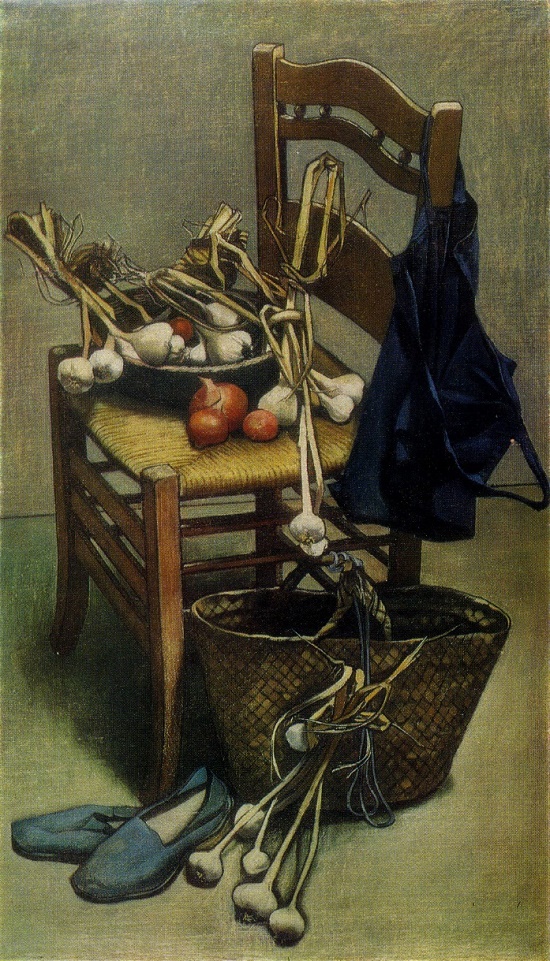
Still life with garlic. 1962. Oil. State museum of art of peoples of the east. Soviet Armenian artists paintings

Soviet Armenian artists paintings
Akop Tigranovich Akopyan (1923-2013), Honored Artist of the Armenian SSR, born in Alexandria (Egypt). He studied at the Art Academy in Cairo from 1943 to 1947, and in the art studio of Gran Chaumieu in Paris from 1952 to 1954. In 1952 he moved to Yerevan. Author of thematic paintings, landscapes, still lifes. Gazing closely at nature, Akop Tigranovich Akopyan seeks to reproduce it with an almost illusory accuracy. However, his creative method is far from naturalism. Reality with its particular weight, concreteness becomes its peculiar formula, a certain metaphor that emphasizes the stability of the world, the certainty of feelings. “Still Life With Garlic” (1962) is a typical example of strong-willed, vigorous handwriting of the artist. Lived and worked in Yerevan.
Read more »
Soviet Kyrgyz painter Gapar Aytiev 1912-1984

Soviet Kyrgyz painter Gapar Aytiev 1912-1984

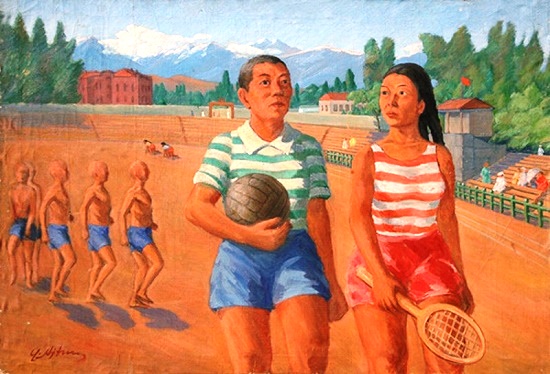
Athletes, 1938. Soviet Kyrgyz painter Gapar Aytiev 1912-1984

Soviet Kyrgyz painter Gapar Aytiev

One of the first professional Kyrgyz artists, a participant in the Great Patriotic War, Aitiev followed the classical Russian tradition of landscape painting. At the same time, he is truly a national artist in the aesthetic perception of various life phenomena and deep connections with the spiritual culture of the Kirghiz people. Born September 28, 1912 in the village of Tuleiken, near the city of Osh, he became the Corresponding Member of the Academy of Arts of the USSR and People’s Artist of the USSR.
In the work of Aitiev, the thematic composition does not occupy an equivalent position with the landscape, although the artist himself attached great importance to it. In his canvases, a coloristic and composition-spatial solution along with a carefully thought out motive is an important creative problem.
Read more »

The heroic way of the Komsomol matchbox labels

The heroic way of the Komsomol matchbox labels

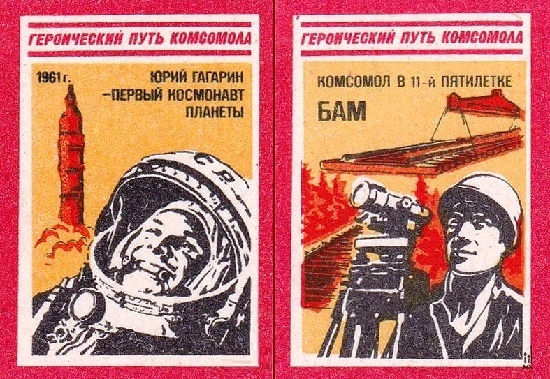
A set of match labels issued in 1984 in the USSR. 1961 – Yuri Gagarin – first man in space, and construction and development of BAM (Baikal-Amur Railway). The heroic way of the Komsomol matchbox labels

The heroic way of the Komsomol matchbox labels

In the above photo – “The heroic way of the Komsomol” set of match labels issued in 1984 in the USSR. It is the work by the artist M.D. Griberg, for Balabanovo Experimental Factory, Kaluga Region. The match labels show episodes of the working life of the Communist Youth League, its slogans and achievements. And now, some information on the history of Soviet Komsomol after the WWII.
November 18, 1958 the newspaper “Komsomolskaya Pravda” looked unusual. The issue opened with an appeal: “Give communist labor brigade!”, “Leninsky Komsomol Communist teams met seven years!” From the pages of the newspaper to the reader looked perky faces of the workers, who proposed on the eve of the XXI Congress of the CPSU to start a new competition – the movement for communist labor. Thus a new, higher stage of socialist competition arose. And the first (in October – November 1958) who most clearly and fully formulated the tasks of the new competition, were young communists and Komsomol members. In particular, workers of the depot Moscow-sorting Kazan Railway, innovators of the Leningrad Metal Plant, and several advanced collectives, among whom were miners of Ukraine, Baku oil, and Belarusian builders. At their suggestion, a competition for the title of collectives of communist labor began. They put forward the motto: “Learn, live and work in a communist way.”
Read more »

Soviet artist Valentina Mikhaylovna Avdysheva 1931-1975

Soviet artist Valentina Mikhaylovna Avdysheva (March 29, 1931 - December 27, 1975)

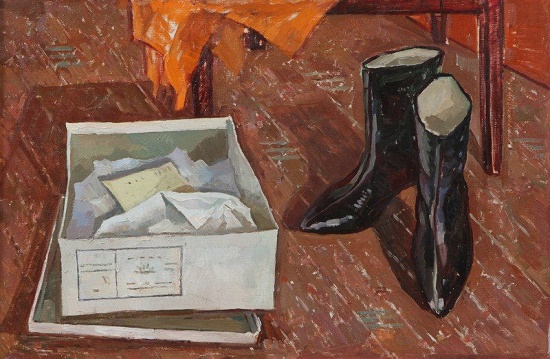
New boots. 1967. Painting by Soviet artist Valentina Mikhaylovna Avdysheva (March 29, 1931 – December 27, 1975)

Soviet artist Valentina Mikhaylovna Avdysheva

Born March 29, 1931 in the Siberian village of Poltavka, Omsk region, Valentina Avdysheva was a painter, graphic and theater artist. She studied at the Leningrad Art and Graphic Pedagogical School (1947-1951). After graduating from the institute, she immediately went to Petrozavodsk, Karelia. Since 1953, she participated in all the annual republican exhibitions of Soviet Art. Meanwhile, Zaonezhie land, and, in particular, Kizhi became her main inspiration. “Clouds over Kizhi”, “Boyarschyna Village”, “Zaonezhsky Islands”, “Evening in Zaonezhye” – creative milestones of her trips to the ancient land of epic story-tellers.
Member of the Union of Artists of the USSR (1968), she led a great public work, being a deputy. Chairman of the Board of the Union of artists, she created the Club of amateur artists of Petrozavodsk. Besides, she worked as the main artist in the Finnish Drama Theater in Petrozavodsk in the late 1960’s and 1970. She created several stage decorations for performances: “Will you accept me, Karelian land” based on the play of A. Timonen, “Ordinary story” by A. Goncharov, and others.
Read more »

The USSR Industry Achievements matchbox labels

The USSR Industry Achievements matchbox labels

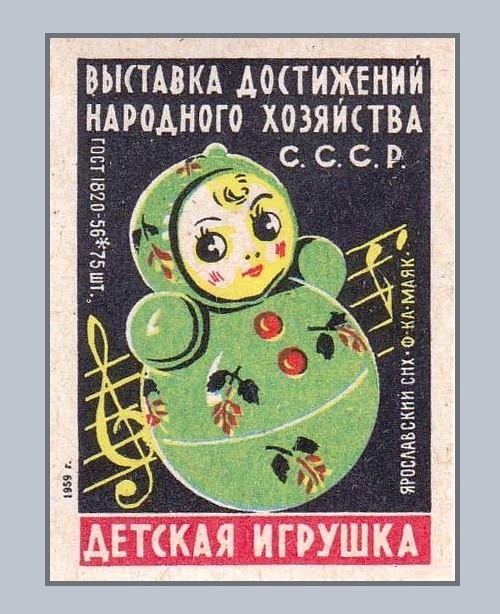
1959 matchstick box label. Children’s toy. From the series The USSR Industry Achievements matchbox labels

The USSR Industry Achievements matchbox labels
The match-sticker label, after the revolution and complete nationalization of match factories dramatically changed its content and purpose. On the labels began to print ideological appeals and slogans, and information about various events, advertising products and services. In the USSR, Phillumeny, in contrast to the numismatics dealing with precious metals, was strongly supported. At the same time, being the most mass media in the USSR (label production reached hundreds of millions), match labels underwent strict censorship. Accordingly, until the middle of the 1950s, every match label was approved with the resolution “Corresponds to the print allowed by Gorlit.”
Meanwhile, in the days of Stalin, it was forbidden to portray the portraits of the “leader of the peoples” on the labels. However, the slogans praising him were greeted. Later, when censorship reduced, a huge number of highly professional mini masterpieces appeared. Never thrown away, they became the collectibles. In fact, they featured all spheres of the life of Soviet society: from everyday objects to flight into space. Soviet people, as well as our contemporaries, carefully considered, exchanged and collected black and white, multicolored, souvenir, greeting and advertising matchboxes made in the Soviet Union.
Read more »

Soviet Turkmen artist Durdy Bayramov 1938-2014

Soviet Turkmen artist Durdy Bayramov 1938-2014

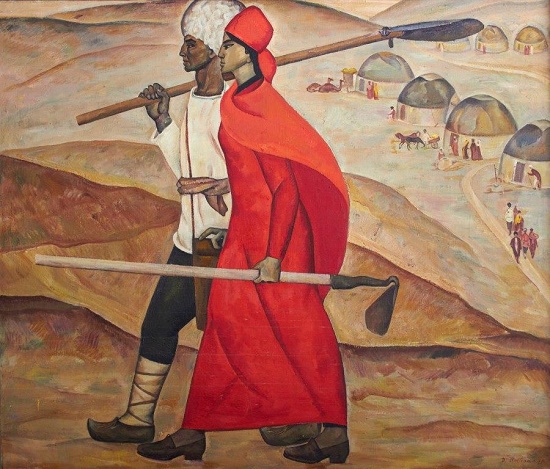
The first. 1968. Painting by Soviet Turkmen artist Durdy Bayramov (April 14, 1938 – February 14, 2014)

Soviet Turkmen artist Durdy Bayramov
Durdy Bayramov (April 14, 1938, Bairam-Ali, Turkmen SSR – February 14, 2014, Ashgabat, Turkmenistan) is a Soviet Turkmen artist, teacher and photographer. Acting member of the Academy of Arts of the Kyrgyz Republic (1998), People’s Artist of the Turkmen SSR (1991), Honored Artist of the Turkmen SSR (1980). He received the President of Turkmenistan’s medal “For Love of the Fatherland” (2008). Laureate of the award of the Union of Artists of Turkmenistan of B. Nurali (2009), the Lenin Komsomol Prize of the USSR (1972) and the Lenin Komsomol Prize of the Turkmen SSR (1970).
Bayramov is the author of more than 5000 works of painting, graphics, and photographs in the gnres of portraits, landscapes, still lifes, and thematic compositions.
Read more »

Soviet Artist Nikolay Pavlovich Yeryshev 1936-2004

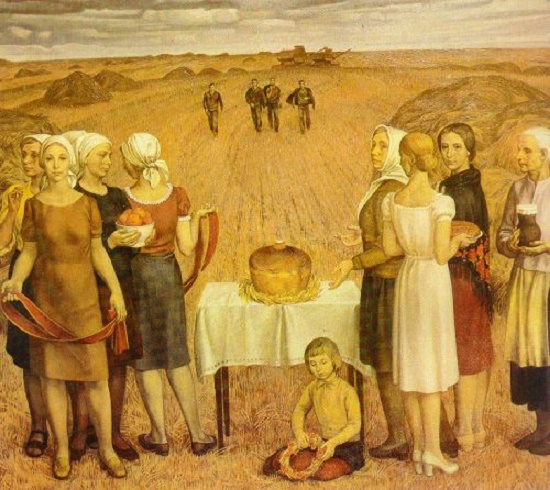
The Bread field. 1979 (Silver medal of the Academy of Arts of the USSR). Painting by Soviet Artist Nikolay Pavlovich Yeryshev (15 June 1936- 31 July 2004

The Bread field. 1979 (Silver medal of the Academy of Arts of the USSR). Painting by Soviet Artist Nikolay Pavlovich Yeryshev (15 June 1936- 31 July 2004

Soviet Artist Nikolay Pavlovich Yeryshev

According to art critics, the work of Nikolai Pavlovich Yeryshev is a most valuable contribution to the artistic history of the USSR. A wonderful master of the subject-thematic picture, Yeryshev managed to rise the history of his country and era to a high philosophical understanding. The artist’s paintings created in 1970-1980, put his name on a par with the classics of Soviet art. In particular, “The Collective Farm Market”, “Carnival in Venice”, “Defense of Orenburg”, “On the grain stock”, “Refugees” and many others.
An artist-monumentalist by profession, he was looking for great, epoch-making themes for his works. Meanwhile, after his first participation in the zonal exhibition, he became the member of the USSR Union of Artists (1965). And in 1967, for the painting “On his land” the artist received the highest award of the All-Union Exhibition of Young Artists. Also, the first personal exhibition of Nikolai Eryshev took place in Moscow in 1973.
Read more »